 תכנון וניהול משק החשמל
Quantum Grid Optimization
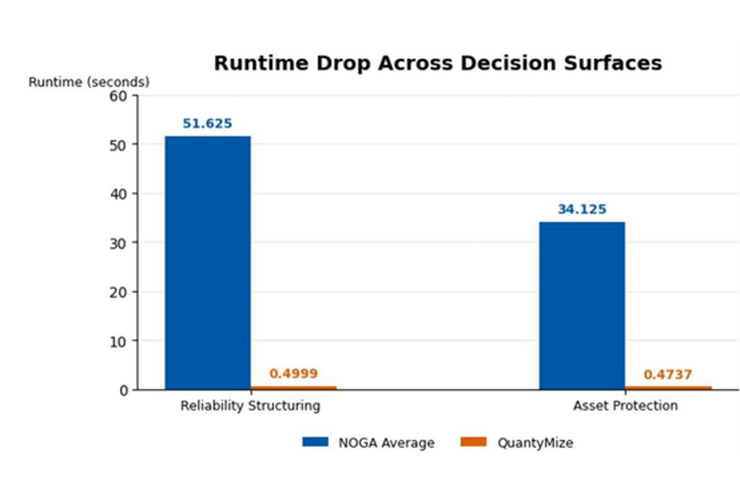
Noga collaborated with quantum software startup QuantyMize to achieve a 100x faster time-to-solution for complex grid planning problems (p. 1). By deploying QuantyMize’s quantum accelerating algorithms, the partnership successfully unlocked massive operational efficiency without compromising accuracy.
The Bottleneck: Decisions Constrained by Complexity
As the modern energy grid scales, critical planning problems quickly become computationally intractable. This forces grid operators into a costly compromise between analytical depth and operational speed:
• Interdependent Variables: Ranging from 80 to 150 critical decision factors.
• Exponential Growth: System configurations grow exponentially 2^{N}, exceeding 10^{24} possible states.
• Time Limits: Classical optimization algorithms require excessively long runtimes, limiting the ability to run real-time risk scenarios.
The Breakthrough: Unlocking Decision Velocity at Scale QuantyMize applied a radically different approach to structuring optimization problems for quantum environments. By drastically reducing computational overhead without simplifying the underlying physical system, calculation times dropped from minutes to mere fractions of a second:
• Reliability Structuring: Runtime plunged from 51.62 seconds down to 0.49 seconds.
• Asset Protection: Runtime plummeted from 34.12 seconds down to 0.47 seconds.
Technology: Unlocking Quantum Hardware Potential The performance gains are fundamentally driven by advanced software modeling rather than relying entirely on raw, physical quantum hardware advancements:
• Efficient Modeling: Executing QuantyMize 'Quantum Accelerated Algorithms' models which make current Quantum computing available to solve complex optimization problems.
• Hybrid Execution: Seamlessly balancing real-time computational workflows between classical processors and quantum platforms (p. 1).
• Broader Operational Impact: The underlying algorithm directly enables a 20% increase in photovoltaic energy generation while simultaneously cutting battery degradation by 50%.