 תכנון וניהול משק החשמל
Forecasting Peak Electricity Demand under Climate Change
Medium-term forecasts of extreme daily temperatures are essential for predicting exceptionally high loads on the national electricity infrastructure, yet they remain challenging because atmospheric dynamics become highly chaotic beyond roughly a two-week time frame.
Moreover, under climate change conditions, the predictive performance of static temperature forecasting models induced from historic data may deteriorate over time.
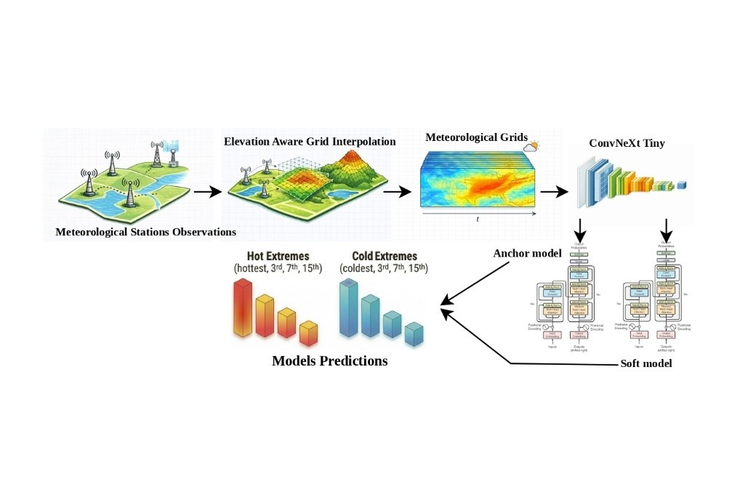
In this research, we focus on developing extreme temperature forecasting models that are responsive to concept drifts caused by climate change. Our models are induced by several time series forecasting techniques, including Prophet, Seasonal AutoRegressive Integrated Moving Average with Exogenous factors (SARIMAX), and Deep Learning.
We have developed a deep learning framework for operator-oriented month-ahead prediction of temperature extremes, based on 20 years of daily observations from 68 meteorological stations in the Israel Meteorological Service (IMS) network. We introduce elevation-aware interpolation that converts heterogeneous measurements into spatiotemporal data frames, capturing topographic temperature gradients. In our forecasting pipeline, ConvNeXt-Tiny encodes daily frames, and a temporal module, either TemporalFusionLite (TFT) or an LSTM, predicts four temperature targets for the upcoming 30-day window: the 1st, 3rd, 7th, and 15th hottest or coldest days in summer or winter months, respectively. These values provide directly actionable thresholds for peak-demand risk envelopes.
We evaluate our pipeline across three geographical regions (Center / Tel Aviv metropolitan area, North-West / Haifa metropolitan area, and the Negev Desert) using strict, chronological backtesting with more than 230 forecast points per region and target type. ConvNeXtTiny--TFT reduces the summer months Mean Average Error (MAE) from ≈4.69 ^∘ "C" for Prophet and SARIMAX to 2.16 ^∘ "C" , and the winter months MAE from 1.80 ^∘ "C"-1.88 ^∘ "C" to 1.39 ^∘ "C" . Moving-block bootstrap and Holm-corrected Wilcoxon tests confirm significant gains over Prophet, SARIMAX, and the tabular data ablation, with p < 0.001 on the main targets. Operationally, a decrease of about 2.5 ^∘ "C" in the monthly error reduces unnecessary energy reserves and missed peak events. The proposed forecasting models are expected to support Noga’s electricity production planning decisions